
Will it run? Wind, time and fetch for downwind foiling

- The three inputs
- Wind speed, how long it has blown (duration) and how far it has blown over open water (fetch).
- Short fetch
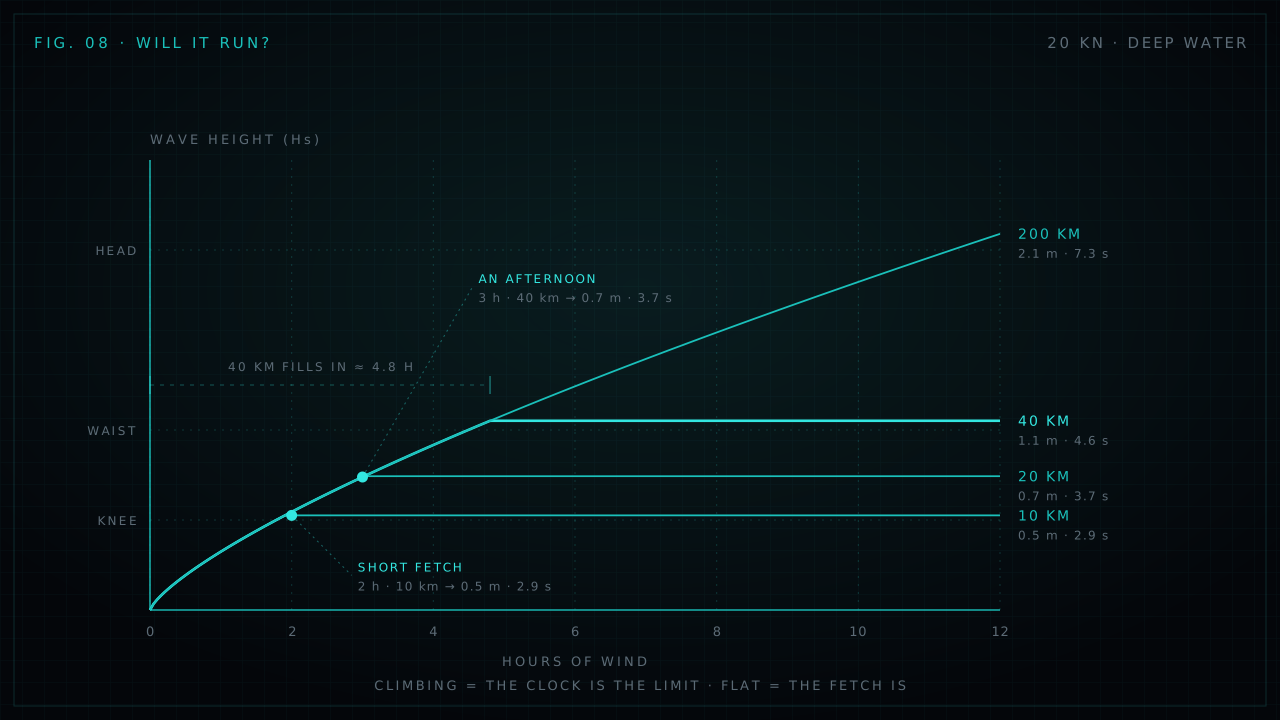
- 20 knots, 2 hours, 10 km: about 0.5 m at 2.9 seconds.
- Longer fetch
- 20 knots, 3 hours, 40 km: about 0.7 m and still growing. That fetch fills in after about 5 hours, at 1.1 m.
- Biggest wave to expect
- Up to about twice the forecast wave height over half an hour of riding.
- Period sets speed
- A 3-second bump travels at about 17 km/h, a 5-second one at 28 km/h.
The forecast says 20 knots. That can mean a gusty, lumpy mess or a steady procession of bumps, and the wind number alone won't tell you which.
What decides it is how long that wind has been blowing, and how much open water it had to work across.
How does wind turn into bumps?
Wind builds waves by pushing on them. Pressure is higher on the back of each wave and lower on the front, so energy flows from the air into the water for as long as the wind keeps blowing faster than the waves are moving.
Three things set how much energy gets in:
- Wind speed. Stronger wind pushes harder.
- Duration. A sea needs hours of steady wind to grow.
- Fetch. The distance of open water the wind crosses before it reaches you.
The sea grows until one of those runs out. On a short fetch the bumps stop growing within an hour or two, however long the wind blows. On a big fetch, the clock is usually the limit: the wind simply hasn't blown long enough yet.
If the wind is angled to your run, the fetch that counts is the distance measured back along the wind direction, not along your downwind line. A long coast with the wind blowing along it can have a much shorter fetch than the map suggests.
What does a forecast actually build?
These are worked examples from the standard deep-water wave-growth formulas, capped at a fully developed sea. Hs is the forecast wave height; Max is the biggest wave to expect in half an hour. Treat both as knee, waist or head-high, not as centimetres. The crest speed column uses the same deep-water relation as the downwind speed post.
| Wind · time · fetch | Limit | Hs | Max, 30 min | Period | Crest |
|---|---|---|---|---|---|
| 15 kn · 3 h · 10 km | fetch | 0.4 m | 0.8 m | 2.7 s | 15 km/h |
| 20 kn · 2 h · 10 km | fetch | 0.5 m | 1.1 m | 2.9 s | 16 km/h |
| 20 kn · 3 h · 40 km | time | 0.7 m | 1.5 m | 3.7 s | 21 km/h |
| 20 kn · 8 h · 40 km | fetch | 1.1 m | 2.1 m | 4.6 s | 26 km/h |
| 25 kn · 3 h · 40 km | time | 1.0 m | 2.0 m | 4.1 s | 23 km/h |
| 20 kn · 12 h · 200 km | time | 2.1 m | 4.2 m | 7.3 s | 41 km/h |
Three things to read from it:
- A 40 km fetch is full after about five hours. Going from three hours to five adds about 40% to the height. Hours six, seven and eight add nothing.
- More wind beats more time. 25 knots for 3 hours nearly matches 20 knots for 8.
- The biggest wave is about twice the forecast height. Hs is the average of the highest third of the waves. Across a few hundred waves, the largest typically lands between 1.7 and 1.9 times that.
Why does a strong-wind day get messy?
A wind sea is never one wave. It's a spread of periods, and they don't all travel the same way. The dominant bumps, the ones worth riding, run close to the wind direction. The shorter, faster-growing waves on top fan out and run at wide angles to it, and the shorter they are, the more sideways they go.
The harder it blows, the more of that short, crossing chop sits on top. The long downwind lines haven't gone anywhere. You just have to look through the texture to find them.
What foil does the forecast call for?
Start from the period, because the period sets how fast the bumps move, and so how fast your foil has to fly to stay on them.
- Under 3 seconds, knee-high. Bumps at 15 to 17 km/h. The frontwing has to fly and glide well at low speed: more area and a high-lift section.
- Around 4 to 5 seconds, waist-high. Bumps at 21 to 28 km/h. The middle of most ranges.
- 6 seconds and up. Bumps at 34 km/h and faster. A faster, lower-drag section holds them without feeling like it's dragging an anchor.
Ride at an angle and you need more speed than the crest itself: 1.4 times as much at 45°, as the downwind speed post shows. Bumps also tend to grow along the run as the fetch behind you lengthens, so the water at the finish is often faster than the water at the start.
Span decides how a frontwing feels through those turns as much as area does. Reading a frontwing by span, profile and area covers that.
Where to start
Check three numbers before you drive: wind speed, how long it has already blown, and how much open water sits upwind of your launch. If any one of them is short, so are the bumps.
Frontwings by size and aspect are on the frontwings page, and the build wizard puts a whole setup together around the one you choose.
Questions
How much wind do you need for a downwind foil run?
Wind speed alone doesn't settle it, because time and fetch matter as much. At 20 knots, two hours over 10 km of open water builds bumps about half a metre high at under 3 seconds. Three hours over 40 km reaches about 0.7 m, and that fetch keeps growing to about 1.1 m after five hours.
What is fetch in downwind foiling?
Fetch is the distance of open water the wind has blown across before it reaches you. Short fetch caps bump size no matter how long the wind blows. Once the wind has blown long enough to use the whole fetch, the sea stops growing, and only more wind or more distance makes it bigger.
What size foil do I need for small downwind bumps?
Small bumps are short and slow: under 3 seconds they travel at roughly 15 km/h. The frontwing has to fly and glide efficiently at that speed, which points to more area and a high-lift section. Once the period passes 5 seconds the bumps run at 28 km/h and up, and a faster section suits them better.
#downwind #wavescience #forecasting #fetch #foilchoice
Keep reading
Custom fuselage geometry: putting the mast where you ride
Two fuselages of the same length can ride completely differently. How OXZA specifies a custom fuselage by three measurements, how the builder works, and how to order one.
OX Loop: a knotless leash loop for every foil board
The OX Loop is a continuous Spectra leash loop rated to 15,000 lb. No knots to tie, on and off in seconds, tight and clean at the plug. Coming soon, $9.99.
Downwind foil speed: the bump is faster than the set
Deep-water crests run twice as fast as their set. That is why bumps overtake you, why dead downwind is slow, and how bump period sets your foil speed.