
True ride height: forget the number on the mast
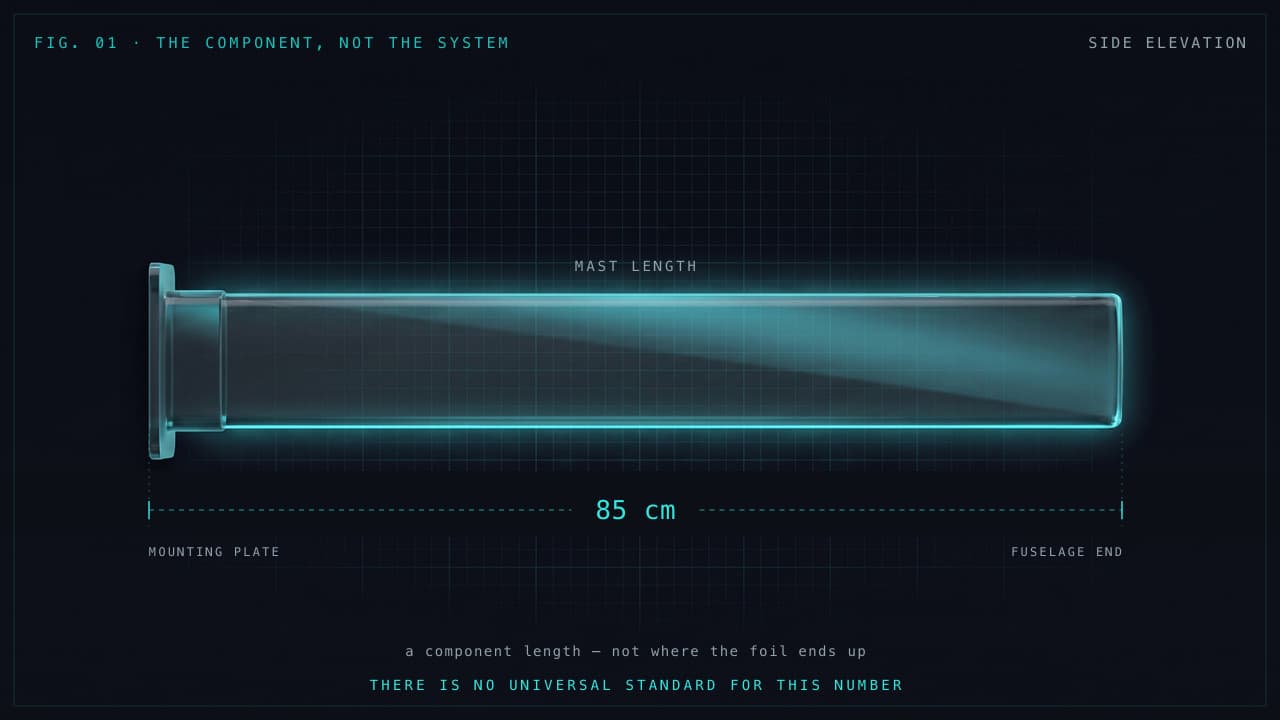
- True foil height
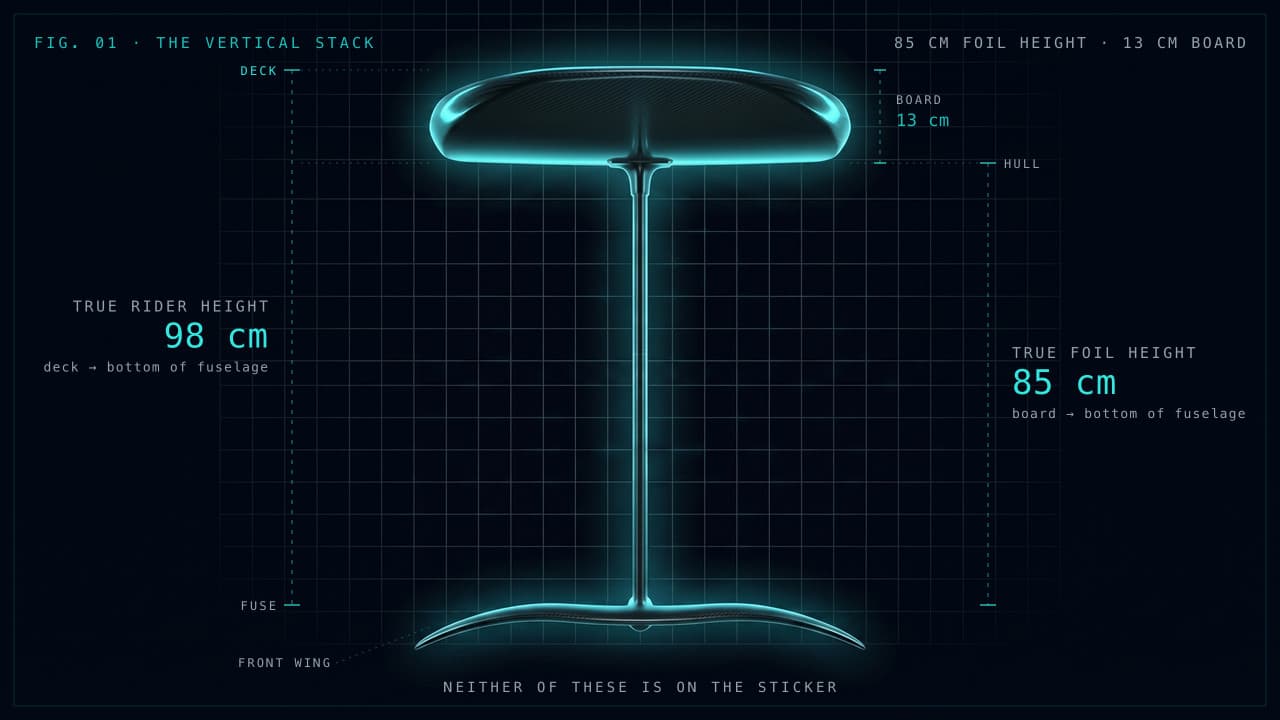
- Bottom of the board to the bottom of the fuselage. Where the foil actually sits relative to the board.
- True rider height
- The deck under your feet to the bottom of the fuselage. How far you are actually standing above the foil.
- Why mast length is not enough
- It starts at the bottom of the board, and you stand on top of the board. The thickness under your feet never appears in the number.
- Typical board thickness
- Most production foil boards are around 13 cm through the standing area — six centimetres more than a thin one, all of it between your feet and the foil.
The hydrofoil industry has always described ride height by mast length. 85 cm. 95 cm. 105 cm.
The problem is that there is no universal standard for exactly where that measurement starts and stops. One manufacturer's 85 cm mast does not necessarily put the foil at the same depth as another's. We have measured an 85 cm mast from another brand on our own bench, from the bottom of the board to the bottom of the fuselage, and read closer to 90 cm.
So what are you actually riding?
Two measurements that matter
True foil height runs from the bottom of the board to the bottom of the fuselage. It tells you where the foil actually sits in relation to the board, and it is the number that decides how high you can fly before the wing approaches the surface.
True rider height runs from the deck under your feet to the bottom of the fuselage. It tells you how far you are actually positioned above the foil.
That second measurement is the one mast length ignores completely. The mast number starts at the bottom of the board. You stand on top of it.
Board thickness is part of ride height
Most production foil boards are around 13 cm thick through the standing area. That is the number nobody quotes, and it is doing more to your ride height than any mast decision you are agonising over.
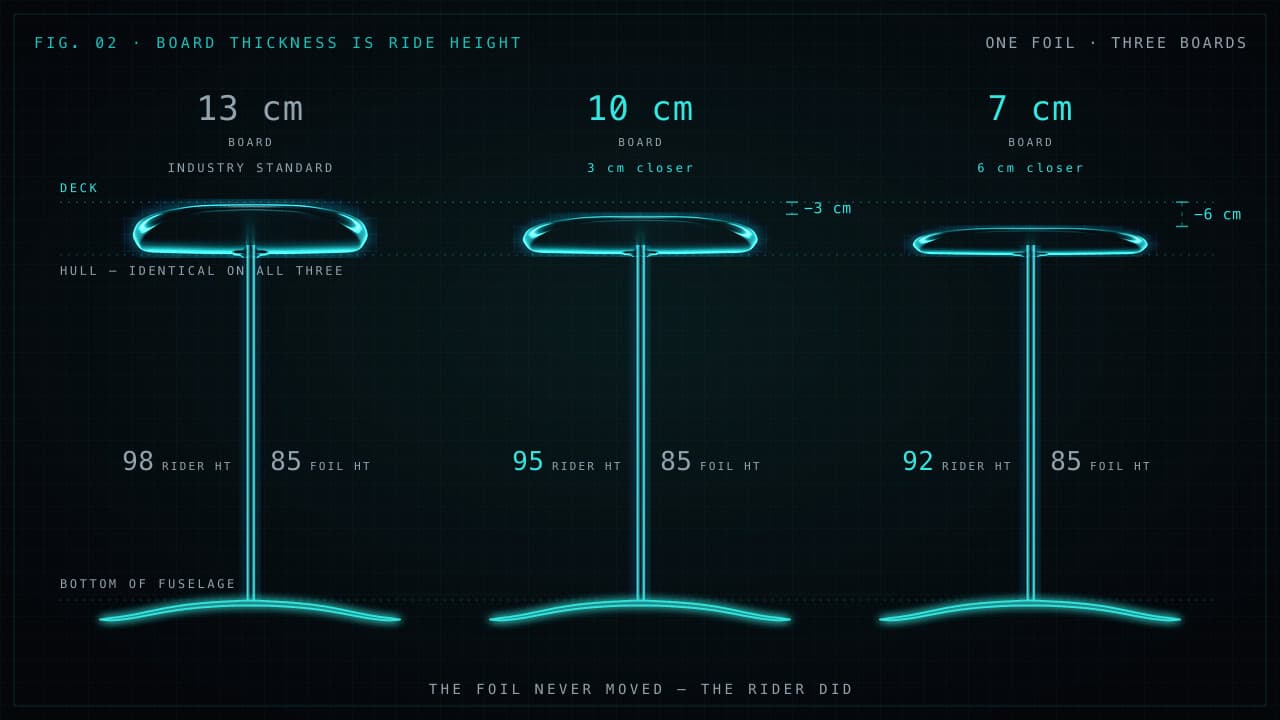
Take a setup with 85 cm of true foil height and put it under that 13 cm board.
85 + 13 = 98 cm true rider height.
Now put exactly the same foil under a 10 cm board.
85 + 10 = 95 cm true rider height.
And under a 7 cm board.
85 + 7 = 92 cm true rider height.
Nothing changed below the board. The foil sits at the same 85 cm in all three, with the same usable height. What moved is you — six centimetres closer to the foil, purely by standing on less board. That shortens the leverage between your feet and the foil and can create a noticeably more direct, more connected feeling.
The math
| True foil height | Board | True rider height |
|---|---|---|
| 85 cm | 13 cm — typical | 98 cm |
| 85 cm | 10 cm | 95 cm |
| 85 cm | 7 cm | 92 cm |
Or spend those centimetres somewhere else
Getting closer to the foil is one thing to do with the thickness you save. It is not the only one.
The centimetres you take out of the board are centimetres you can put back into true foil height and still stand exactly where you stand today. Drop from a 13 cm board to a 7 cm one and you have six of them to spend. Spend them all downward and your feet stay at 98 cm while the foil gains six centimetres of usable height below the board — more clearance before the wing comes near the surface, no change in how high you are standing.
So a thinner board is not one benefit. It is a budget, and you decide where it goes:
- Keep the foil height and bring your feet closer, for a more direct connection.
- Put it back into foil height and gain usable clearance below the board at the same rider height.
- Split it — some of each.
Why this matters
A mast's advertised length does not necessarily tell you how deep the foil sits. It definitely does not tell you how high your feet are above it.
That is why we think the industry has been looking at this from the wrong direction. Instead of starting with the component and asking "what length mast am I riding?", start with the complete system and ask "where is my foil, and where are my feet?"
That is your true ride height.
Measure your own board at the front foot — that is where your weight is, and it is rarely the thickest point. If it comes in near 13 cm you are on a normal board, and that is the point: normal is thick. Add it to the foil height underneath, then hold that sum steady when you change either part.
Mast lengths and profiles are on the masts page, and the mast selection guide covers where each length lands by discipline and skill. The horizontal lever works the same way — see the fuselage selection guide. And if you are choosing a frontwing by the number on the box, don't judge a foil wing by area alone makes the same argument about a different spec.
The build wizard keeps the connection right across whatever combination you land on.
Questions
How is hydrofoil mast length measured?
There is no universal standard, which is the problem. Manufacturers do not all start and stop the measurement in the same place, so two masts both sold as 85 cm can put the foil at different depths. Measure the system instead: true foil height is the bottom of the board to the bottom of the fuselage, and true rider height is the deck under your feet to the bottom of the fuselage.
What is true rider height on a hydrofoil?
The distance from the deck under your feet to the bottom of the fuselage — how far you are actually standing above the foil. Mast length ignores it completely, because the mast number starts at the bottom of the board and you stand on top of the board. A setup with 85 cm of true foil height under a 10 cm board gives 95 cm of true rider height.
How thick is a typical foil board?
Most production foil boards land around 13 cm through the standing area, and plenty are thicker. That thickness is invisible in a mast measurement but it sits directly between your feet and the foil, so a 13 cm board on 85 cm of true foil height gives 98 cm of true rider height.
Does board thickness affect how a hydrofoil rides?
Yes, and it is part of the measurement rather than separate from it. Take the same foil under a 13 cm board, a 10 cm board and a 7 cm board: true foil height never changes, but true rider height goes 98, 95, 92. Your feet move closer to the foil, which shortens the lever between you and it and tends to feel more direct.
Should I change mast length when I change boards?
Check the total, not the component. Going from a 13 cm board to a 7 cm one moves your feet 6 cm closer to the foil unless you add that back. You can keep the thinner board and enjoy the more direct feel, or put some of those centimetres back into true foil height and end up standing where you already stand with more foil below the board.
#truerideheight #mastlength #boardthickness #setup #foiltheory
Keep reading
Custom fuselage geometry: putting the mast where you ride
Two fuselages of the same length can ride completely differently. How OXZA specifies a custom fuselage by three measurements, how the builder works, and how to order one.
Will it run? Wind, time and fetch for downwind foiling
Bump size comes from three inputs: wind speed, how long it has blown, and how much open water it crossed. Read all three and you know the size and the foil.
OX Loop: a knotless leash loop for every foil board
The OX Loop is a continuous Spectra leash loop rated to 15,000 lb. No knots to tie, on and off in seconds, tight and clean at the plug. Coming soon, $9.99.