
Why the fuselage decides how your hydrofoil rides

- What it sets
- The distance between frontwing, mast and stabilizer
- Shortest REVSTAR fuselage
- FU600 — 600 mm, quickest pitch response
- Longest
- FU1000 — 1000 mm, most damped, race windfoil
- Range across the family
- 400 mm of stabilizer position, on the same wing
What does the fuselage actually decide?
A fuselage is usually described as the part that connects the wings to the mast. That is what it does. It is not what it decides.
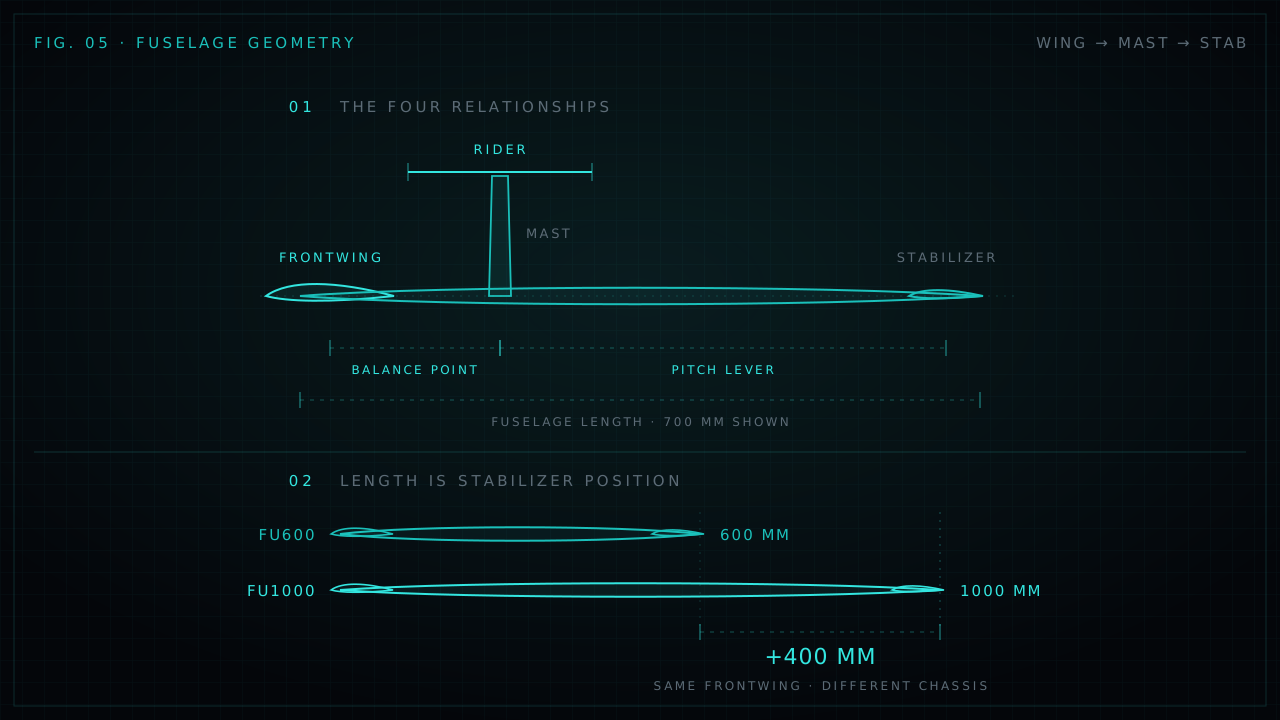
Its geometry sets four relationships at once — frontwing, mast, stabilizer, rider — and every one of them is a number you feel:
- Where the mast meets the fuselage relative to the frontwing sets the balance point. It decides where your weight sits against the lift, and how much of the foil's behaviour arrives through your front foot rather than your back one.
- How far back the stabilizer sits sets the lever that damps pitch. A longer lever resists a pitch input; a shorter one lets the nose move.
- The stabilizer's own setup — size and the angle it runs at — decides how hard you have to push against the foil to hold height, and how freely the tail will let the foil rotate into a turn.
Bolt the same frontwing onto two different fuselages and you have two different foils. That is not a marketing claim; it is the same wing with a different chassis under it.
Why does fuselage length change how a foil turns?
Because length is stabilizer position. Moving the tail back adds damping in pitch, and damping in pitch is what a rider reads as stable — and, from the other side, as slow to answer.
| Fuselage | Length | Pitch response | Turn character |
|---|---|---|---|
| FU600 | 600 mm | Quickest — small input, immediate answer | Tightest arc; freestyle and speed |
| FU700 | 700 mm | The all-around middle | Balanced; the default choice |
| FU860 | 860 mm | Damped — holds a line through chop | Wider, more deliberate; glide and downwind |
| FU1000 | 1000 mm | Most damped, built for high load | Race lines; windsurf foil only |
Four hundred millimetres separate the ends of that range. Nothing about the frontwing has changed across the row.
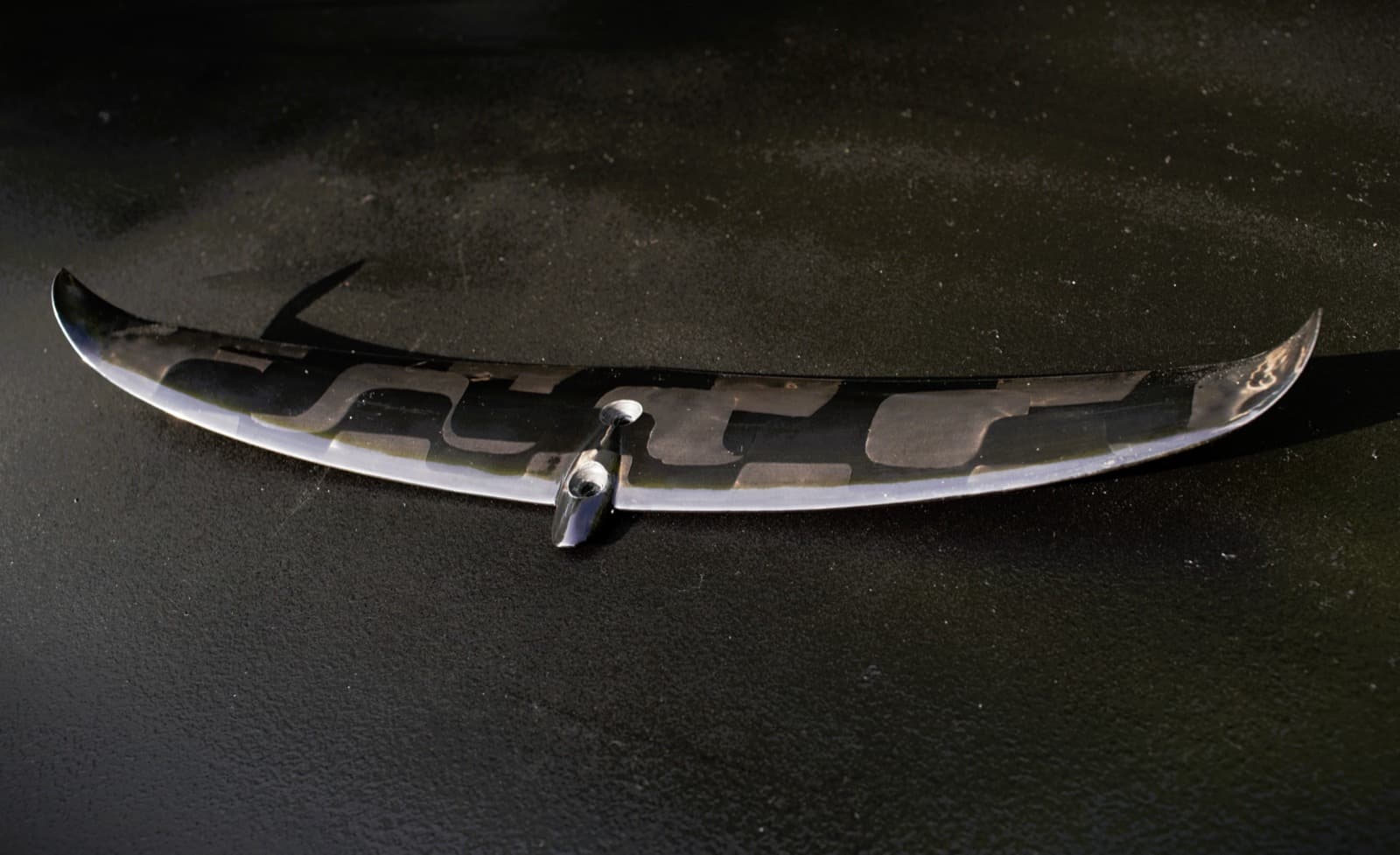
The useful way to think about it is wheelbase. Short is a go-kart and long is a touring car, and neither one is the correct answer — the correct answer is the one that matches what you are trying to do on the water. The fuselage selection guide has the pairing detail; the stabilizer pairing guide covers the tail end of the same argument.
What changes if you start from the rider instead of the wing?
Riders want genuinely different things. One wants tight carving and a loose, reactive foil. One wants speed and control. One wants maximum glide. One wants to pump. One wants to race. One wants a single system that can move between several of those.
Those riders do not need the same fuselage length, the same mast position, or the same stabilizer relationship. Designing one geometry and asking all of them to adapt to it is a decision — usually a decision made because a single geometry is cheaper to tool.
Starting from the other end changes the order of the questions. What is this rider trying to do, and what geometry does that ask for? The frontwing is still critical. It just becomes one part of a system instead of the part that defines everything else.
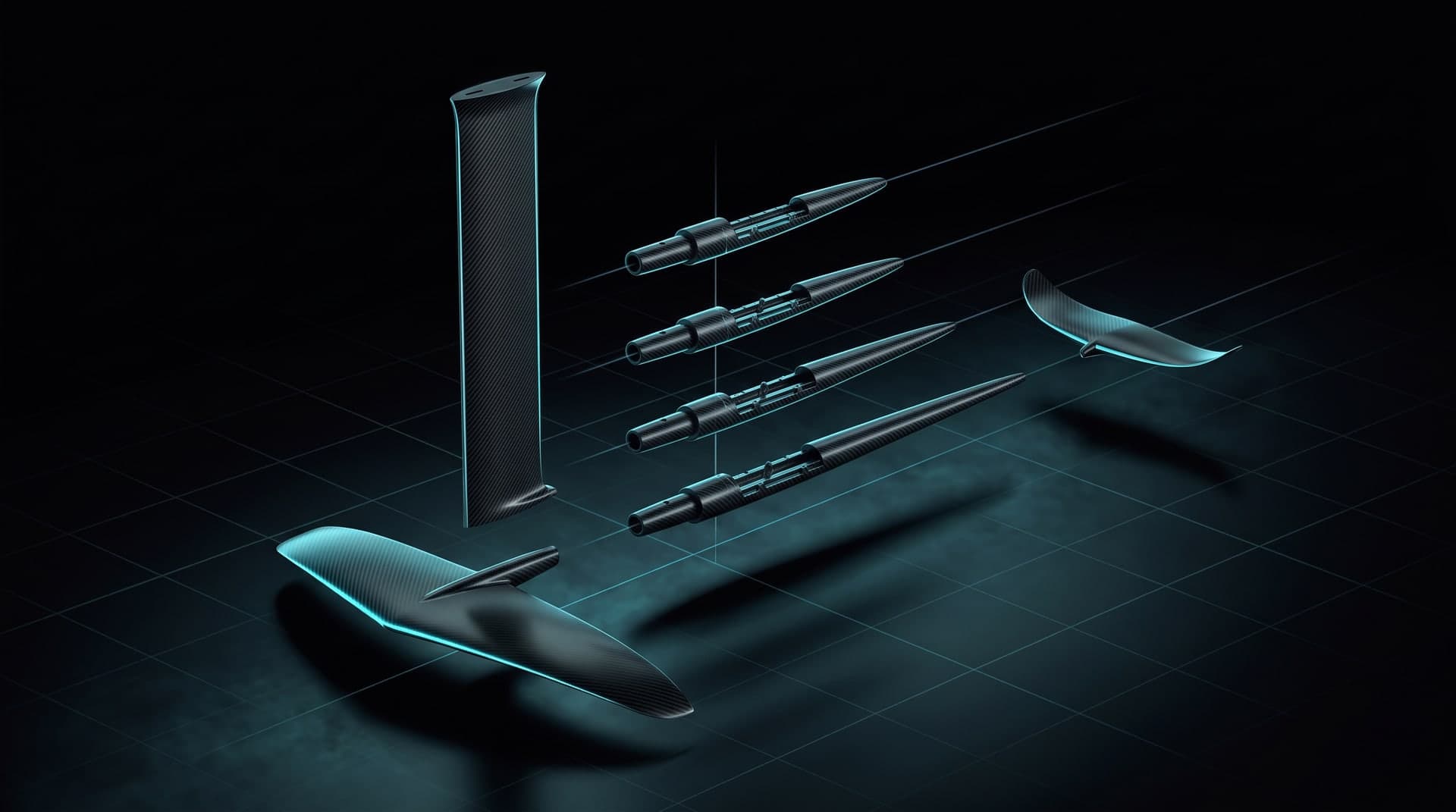
That is also why the two numbers riders reach for first are both incomplete on their own. A mast is measured to the bottom of the board, not to your feet — see foil mast height: what are you really riding?. And a frontwing is not readable from its area — see don't judge a foil wing by area alone. The fuselage is the third of those numbers, and it is the one nobody prints on a sticker.
Does the connection have to be OXZA's?
Not today, and that is deliberate.
Every REVSTAR fuselage length is built in a T8 version as well as an OX Lock version. T8 is the interface most riders already own, so a rider with T8 frontwings can run the OXZA platform and keep the wings — the fuselage is the part that decides which wings fit, so it is also the part that lets you change lanes later. The OX vs T8 migration guide covers the order to do that in.
What OXZA will not sell is an OX-to-T8 adapter. An adapter is another joint, and a joint is the thing a connection system exists to eliminate. A native fuselage in the interface you already ride is a different object from a shim between two that disagree.
Start with the geometry
Choose the mast height you want to ride. Choose the fuselage length that matches how you want the foil to answer. Choose the stabilizer that sets how hard you have to work. Then choose the frontwing that fits what you are trying to do — with the chassis already built around you rather than the other way round.
The fuselage catalog has all four lengths in aluminium, carbon and titanium, in both connections. The build tool checks the whole setup for compatibility as you pick it, and the wings page is where the last decision goes.
Questions
What does a hydrofoil fuselage actually do?
It sets the distances between the frontwing, the mast and the stabilizer. Those three relationships decide the balance point under the rider's feet, how quickly the foil answers a pitch input, and how freely it turns. The fuselage is the chassis of a foil, not just the tube the wings bolt to.
Does fuselage length change how a hydrofoil turns?
Yes. A shorter fuselage puts the stabilizer closer to the frontwing, which shortens the lever damping pitch — the foil answers faster and carves a tighter arc. A longer fuselage moves the stabilizer back, damps pitch and holds a line. REVSTAR spans 600 mm to 1000 mm, a 400 mm range.
Can you run another brand's frontwings on an OXZA fuselage?
If they are T8 wings, yes. Every REVSTAR fuselage length is built in a T8 version as well as an OX Lock version, so a rider on T8 wings mounts them natively without an adapter. OXZA does not sell an OX-to-T8 adapter, because an adapter adds the joint a connection system exists to remove.
#fuselage #geometry #stabilizer #mastposition #foiltheory
Keep reading
Custom fuselage geometry: putting the mast where you ride
Two fuselages of the same length can ride completely differently. How OXZA specifies a custom fuselage by three measurements, how the builder works, and how to order one.
Will it run? Wind, time and fetch for downwind foiling
Bump size comes from three inputs: wind speed, how long it has blown, and how much open water it crossed. Read all three and you know the size and the foil.
OX Loop: a knotless leash loop for every foil board
The OX Loop is a continuous Spectra leash loop rated to 15,000 lb. No knots to tie, on and off in seconds, tight and clean at the plug. Coming soon, $9.99.