
Why a small foil stabilizer shim changes so much
- The equation
- Pitch control = stabilizer force × lever arm
- What the fuselage sets
- The lever — 600 mm to 1000 mm across REVSTAR
- What the shim sets
- The force — stocked at 0.5°, 1° and 1.5°
- Why speed matters
- Hydrodynamic force rises with the square of speed
Why does length only get you halfway?
Fuselage length gives the stabilizer leverage. That is the first half of the argument, and on its own it does not tell you how the foil will feel.
The other half is how much force the stabilizer is producing. That comes from its area, its profile, the angle it is running at, the speed you are going, and the length of the lever between it and the frontwing.
Put those together and you have the pitch-control power of the whole system:
Pitch control = stabilizer force × lever arm.
A given force at the end of a long lever has more authority than the same force on a short one. Which means a designer has a choice.
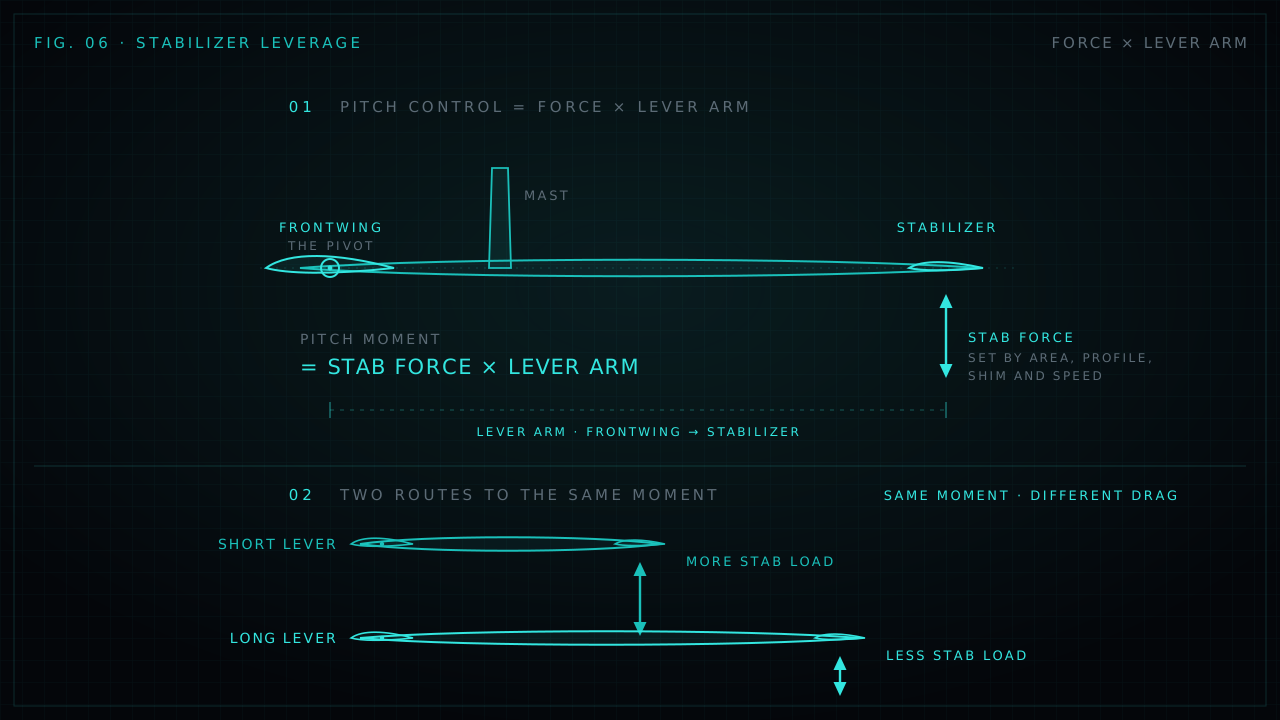
What are the two routes to the same moment?
More force on a shorter lever, or less force on a longer one. Both can reach a similar pitch moment about the frontwing. They do not produce the same drag, and they do not feel the same underfoot.
| Shorter rear fuselage | Longer rear fuselage | |
|---|---|---|
| Lever arm | Short | Long |
| Force needed for the same moment | More | Less |
| Route to it | More area, more load, more incidence — or all three | Smaller stab, lower loading, less incidence |
| Drag as speed rises | Climbs faster | Stays lower |
| Feel | Livelier, quicker to answer | Settled, holds a line |
The stabilizer pairing guide already says the practical version of this: a longer fuselage with a small stab is roughly a shorter fuselage with a bigger one, in stability terms. This is why.
Why does that matter for drag?
Producing force is not free. A stabilizer being asked to work harder carries a higher load, and as the lift coefficient it has to run at goes up, its induced drag goes up with it. Depending on the profile and the angle it is sitting at, profile drag can climb too.
That matters most at speed, because hydrodynamic force grows quickly with speed.
So rather than asking a small stabilizer on a short lever to work very hard, you can move the stabilizer further back and spend the extra leverage on making the tail work less. Smaller stabilizer, lower loading, lower operating lift coefficient, less drag — with the pitch control the rider actually needs left intact.
That is one reason long race fuselages make sense. Not because racers want a foil that feels stable. Because tail leverage is part of the efficiency equation, and FU1000 is where that argument ends up.
Why does the setup that felt right stop feeling right?
Because hydrodynamic force rises roughly with the square of speed. Double the speed and, at the same lift coefficient, the force available is about four times greater.
A stabilizer setup that felt balanced at low speed can be carrying more load than it needs as the speed comes up. The rider feels it as foot pressure that keeps building. The stabilizer is also making more drag than the setup requires.
Which is why high-speed foil design is not a matter of making everything smaller. It is a matter of producing the control forces you need efficiently — the same argument that says a frontwing is not readable from its area, one component further back.
What is a shim actually for?
Shimming changes the stabilizer's incidence relative to the rest of the foil, and so changes the force it makes at a given condition. Load the tail up and you get a stronger pitch moment; riders usually read that as a shift in front-foot or rear-foot pressure, which way round depending on the stabilizer configuration and which way the shim goes. Take load off and the foil feels freer, asking less of you to hold it.
A fraction of a degree does that because you are not adjusting a small rear wing in isolation. You are changing a force at the end of a lever.
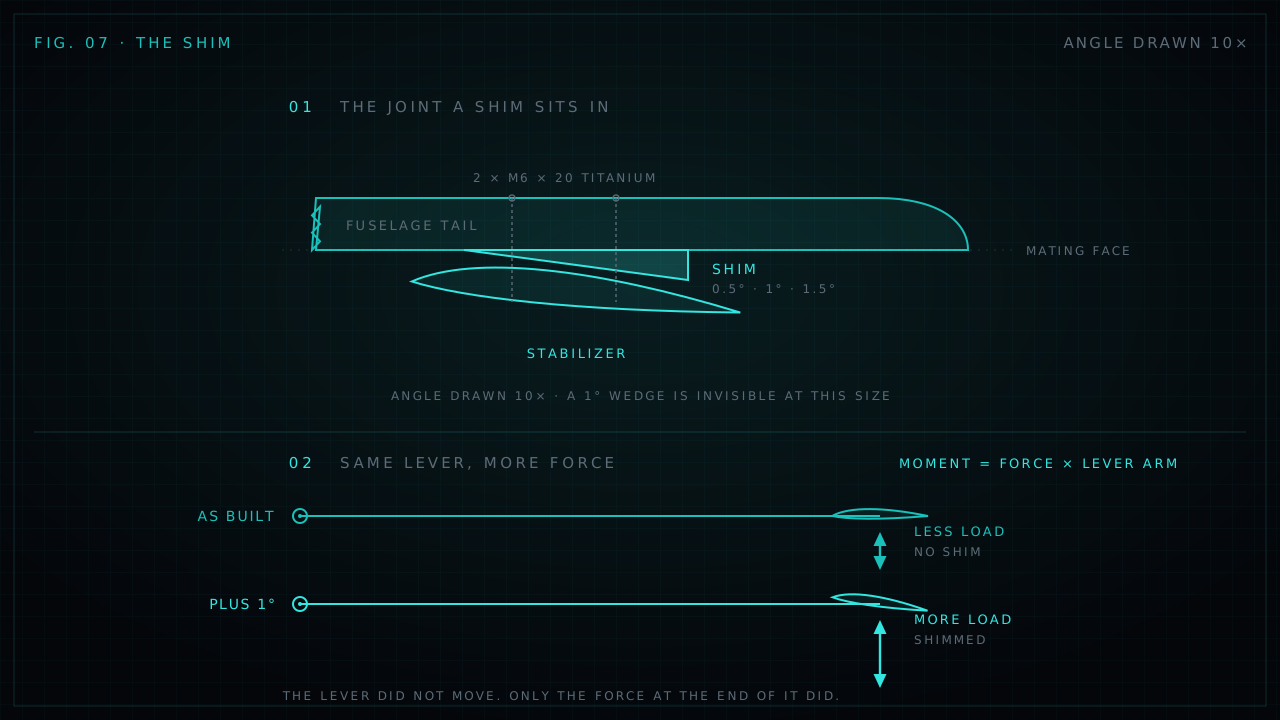
Shims are a tuning tool. They are not a fix. The fuselage geometry, the frontwing position, the mast position and the stabilizer should be designed to work together first — and then the shim does what it should: fine tuning, not compensation for geometry that was wrong to begin with. The shim set is stocked in 0.5°, 1° and 1.5° for exactly that reason, and no larger.
The four variables, and the order to set them
The chassis is four decisions, not one:
| Variable | The question it answers |
|---|---|
| Frontwing position | Where is the primary lifting surface? |
| Mast position | Where does the rider enter the system relative to that lift? |
| Stabilizer position | How much leverage does the tail have? |
| Stabilizer load / incidence | How much force are we asking the tail to make? |
Which is why the question is never simply "how long should the fuselage be?" It is: how much pitch-control moment does this rider need, where should the force come from, and how efficiently can we produce it?
Leverage before load. Use geometry to create the leverage, the stabilizer to create the force, and the shim to fine-tune the balance — and do not build in drag to compensate for geometry.
Pick the fuselage length that sets the lever, then the stabilizer that sets the force, and the build tool will check the pair against the frontwing as you go.
Questions
What does a stabilizer shim actually change on a hydrofoil?
A shim changes the angle the stabilizer runs at relative to the rest of the foil, which changes how much force the stabilizer produces at a given speed. Because that force acts at the end of a long lever, a fraction of a degree becomes a noticeable change in pitch balance. REVSTAR ships shims in 0.5, 1 and 1.5 degrees.
Does a longer fuselage need a smaller stabilizer?
It allows one. Pitch control is stabilizer force multiplied by the lever arm between the stabilizer and the frontwing, so a longer fuselage can reach the same pitch moment with less force from the tail. That is why a longer fuselage with a small stabilizer and a shorter fuselage with a bigger one can feel similarly stable.
Why does a hydrofoil that felt balanced at low speed feel loaded at high speed?
Hydrodynamic force rises roughly with the square of speed, so at double the speed the same stabilizer at the same angle can be making about four times the force. The rider reads that as increasing foot pressure, and the stabilizer is also making more drag than the setup needs.
#stabilizer #shims #pitchcontrol #drag #fuselage
Keep reading
Custom fuselage geometry: putting the mast where you ride
Two fuselages of the same length can ride completely differently. How OXZA specifies a custom fuselage by three measurements, how the builder works, and how to order one.
Will it run? Wind, time and fetch for downwind foiling
Bump size comes from three inputs: wind speed, how long it has blown, and how much open water it crossed. Read all three and you know the size and the foil.
OX Loop: a knotless leash loop for every foil board
The OX Loop is a continuous Spectra leash loop rated to 15,000 lb. No knots to tie, on and off in seconds, tight and clean at the plug. Coming soon, $9.99.